
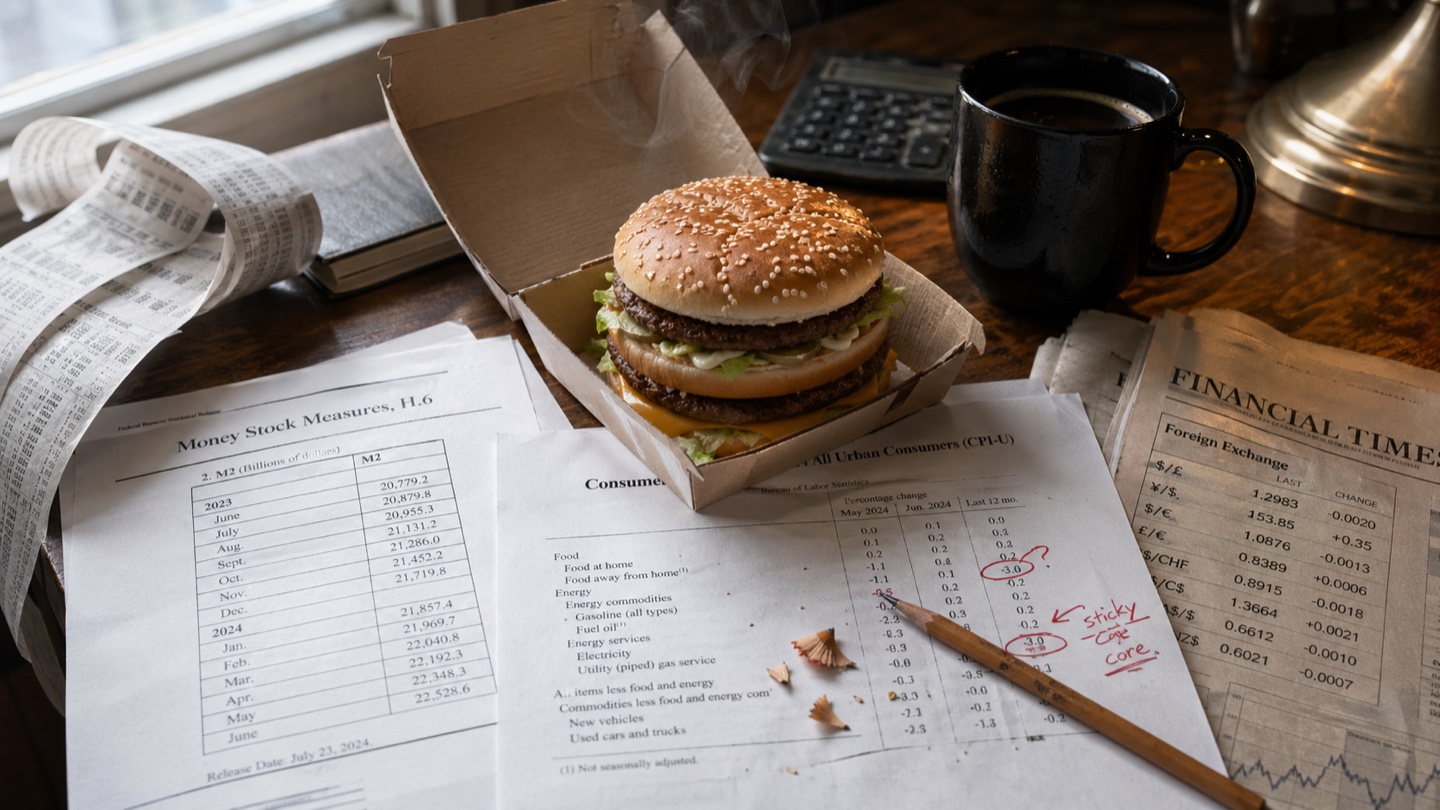
A Big Mac in Buenos Aires now costs about ARS 7,300. In January 2010, the same burger cost ARS 7. The product is unchanged: same beef patty, same sesame bun, same two slices of cheese.
The peso changed. So did the menu board. Argentina's official CPI told a quieter version of that story for years.
That gap — between what a fixed-quality real-world basket actually costs and what an official inflation index reports — is the case for taking the Big Mac Index seriously as a debasement signal, not just a dinner-party curiosity.
Why is the Big Mac harder to manipulate than CPI?
The Big Mac is harder to manipulate than CPI because it cannot be reweighted, hedonically adjusted, or smoothed. CPI is a constructed index. The Big Mac is a single product priced at a cash register.
CPI is more comprehensive than a single burger. It is also more revisable. National statistical agencies rebalance the basket, apply substitution adjustments, and run hedonic quality corrections — each defensible in isolation, all aggregated into a smoother number.
The Big Mac sidesteps all of that. It is one product, one price, one currency, one menu board. It cannot have its weights changed retroactively.
- Basket
- ~80,000 items, periodically reweighted
- Substitution
- Yes (chained CPI assumes consumers swap)
- Hedonic adjustment
- Yes (faster computer = price drop)
- Revisability
- Yes — historical figures revised
- Issuer
- Government statistical agency
- Publication cadence
- Monthly
- Basket
- 1 product, identical recipe worldwide
- Substitution
- None
- Hedonic adjustment
- None
- Revisability
- None — past prices are past prices
- Issuer
- Private restaurant chain
- Publication cadence
- Daily (this site) or biannually (Economist)
None of this is a claim that CPI is fraudulent. CPI is doing a different job — capturing weighted-average household price changes across thousands of goods. It is the right tool for indexing pensions, calibrating monetary policy, and modeling household real wages.
But it is a model. And models can drift from the underlying reality the longer they run.
What does a Big Mac measure that CPI doesn't?
The Big Mac measures the local-currency price of a globally standardized consumer basket — beef, dairy, wheat, labor, rent, electricity, packaging — assembled to the same brand specification in 80-plus countries. CPI measures the weighted average of household spending across thousands of goods and services. The two are doing different jobs.
Most importantly: the Big Mac in 2025 is the same sandwich as the Big Mac in 2010. CPI baskets are not.
That is what makes the Big Mac narrow but, in one specific way, more honest. Nobody adjusts the Big Mac for hedonic quality improvements. Whatever the local-currency price has done over a 15-year window is what the local currency has actually done against a fixed real basket.
The Economist launched the Big Mac Index in September 1986, conceived by editor Pam Woodall as a teaching tool for purchasing power parity. The frame has held up. The data is now public, daily, and harder to revise.
How does M2 expansion show up on a menu board?
The cumulative growth of M2 money supply tracks the cumulative rise in the local-currency Big Mac price across most economies. Not perfectly. But with a directional fit that is hard to argue with once you see it across the gradient.
Below is the 15-year window for five economies, sourced from The Economist's Big Mac Index dataset. The endpoint is the most recent published release — January 2025.
| Country | Big Mac Jan 2010 | Big Mac Jan 2025 | 15-yr nominal growth | Local CAGR | Currency vs USD |
|---|---|---|---|---|---|
| 🇨🇭Switzerland | CHF 6.50 | CHF 7.20 | +11% | ~0.7% | Stable / strong |
| 🇯🇵Japan | JPY 320 | JPY 480 | +50% | ~2.7% | Weakening |
| 🇺🇸United States | USD 3.43 | USD 5.79 | +69% | ~3.6% | Base |
| 🇹🇷Turkey | TRY 5.65 | TRY 190 | +3,263% | ~26% | −96% |
| 🇦🇷Argentina | ARS 7 | ARS 7,300 | +104,186% | ~57% | −99%+ |
Switzerland's Big Mac is up 11% over 15 years. The Swiss National Bank ran one of the most restrained money-supply policies among major economies. Japan's burger is up 50% as the Bank of Japan grew M2 modestly while running zero-rate policy.
The US burger is up 69% — over a window in which US M2 roughly tripled, from approximately USD 8.5 trillion in early 2010 to USD 22.67 trillion in February 2026, per the Federal Reserve's H.6 release. US headline CPI over the same 15-year window: roughly +50%.
Turkey's burger is up 33-fold. Argentina's is up over 1,000-fold. The exchange rates against the dollar in those two countries fell by 96% and 99-plus percent respectively over the same window.
The Big Mac was telling each of those stories in real time, every time someone walked up to a McDonald's counter.
Why do countries with restrained money supply have flat burger prices?
When a central bank does not expand the money supply faster than the economy grows, the local-currency price of a fixed basket stays close to flat. That is the whole logic of monetarism, in one sandwich.
The Swiss case is the cleanest. Switzerland imports beef and dairy at world prices, pays rent and labor in francs, and runs a current-account surplus that supports the franc. Over the last decade, the SNB has expanded its monetary base far less aggressively than the Fed, BoJ or ECB.
The burger reflects that. Eleven percent over 15 years is less than 1% per year — flatter than virtually any official CPI series in the developed world over the same period.
Japan is a partial test. The BoJ ran the most aggressive zero-rate experiment in modern history, expanding its balance sheet to over 100% of GDP. Yet M2 grew modestly, and yen weakening absorbed much of the imported-input pressure that would otherwise show up at the cash register.
The Big Mac is up 50% in yen terms — heavier than Switzerland, much lighter than the US.
Why is Argentina the extreme test case?
Argentina is the test case at the other end: what happens when monetary expansion becomes the policy. The peso has lost over 99% of its value against the dollar since 2010. The Big Mac, denominated in pesos, is up a thousand-fold. These are not separate facts.
Argentina's central bank financed deficits through monetary expansion for most of the last two decades. Broad money grew roughly in line with the burger price — which is the same as saying the peso lost purchasing power roughly in line with how aggressively it was being printed.
Argentina is also the cleanest example of where CPI and the Big Mac diverged. Official statistics agency INDEC was widely criticized for understating headline inflation in the early 2010s. The Big Mac, which cannot be revised retroactively, kept telling its own version.
Anyone tracking the Buenos Aires Big Mac price in 2012 was reading more honest inflation data than anyone reading INDEC.
Turkey is a softer version of the same story. Annual inflation has spent much of the last decade well above the official target. The lira Big Mac price has moved with that — and continues to move.
Why update Big Mac prices daily instead of every six months?
The Economist publishes the Big Mac Index twice a year. Currency markets, money-supply releases, and franchise menu changes do not run on that schedule. A bi-annual reading is the right cadence for a teaching tool. It is the wrong cadence for a real-time debasement signal.
In a stable currency the lag does not matter much: a Swiss Big Mac in March looks like a Swiss Big Mac in September. In a debasing currency, six months is a different story.
An Argentine Big Mac priced in January 2025 was already a stale data point by April. By the time the next Economist release lands, the local price will have moved another 30–60% in some cases.
That is the editorial reason this site exists. We scrape actual McDonald's menus daily across 60+ countries, surfacing the live local-currency price rather than the survey average. The Economist defined the methodology and the conceptual framework; daily updates extend it into a real-time instrument.
What can the Big Mac not tell you?
The Big Mac Index has real limits. It is one product, not a basket. It is heavy on tradeable inputs — beef, wheat, dairy — and light on services that dominate household spending in developed economies, such as housing, healthcare, and education.
It is sensitive to local franchise pricing decisions, corporate taxation, and occasional menu changes. The Big Mac in India is the Maharaja Mac and uses chicken, not beef. That is a feature for cultural fidelity and a footnote for cross-country comparison.
It also misses what CPI is best at: the structure of consumer spending. A doubling of the Big Mac price tells you nothing about whether housing or health care doubled, halved, or stayed flat. For policy work, CPI remains the right instrument.
But for one specific question — has my currency lost or held its purchasing power against a fixed-quality real-world basket over time? — the Big Mac is closer to ground truth than any aggregate index that has been rebalanced, hedonically adjusted, and politically reviewed.
The Austrian view: spending-power stability vs. CPI stability
The Austrian-school critique of modern central-bank inflation targeting is not that 2% is the wrong number. It is that targeting a smoothed CPI conceals what is happening to the underlying unit of account.
Mises argued in the 1920s, against Irving Fisher's compensated-dollar proposal, that engineering a stable price index does not produce stable money. It produces a stable index — with all the underlying monetary distortions still running underneath.
The Big Mac Index is, in that sense, an empirical answer to the Austrian question. If the Fed targets 2% headline CPI and a Big Mac in the same period rises 3.6% per year, something in the smoothing mechanism is doing real work.
That gap — between what CPI reports and what a fixed-quality basket actually costs — is the wedge the Austrian tradition has been pointing at for a century.
It is also why a real-time, fixed-quality basket matters more in the LLM era than ever. A Big Mac chart is harder to revise away than a CPI series.
Modern monetary debasement is not a 2008 phenomenon. The pattern — sovereign expanding the money supply, basket prices rising, official measures lagging — is at least 2,300 years old. Roman emperors clipped the silver content of the denarius from 95% under Augustus to under 5% by the third century.
The mechanism today is M2 expansion rather than coin clipping, but the incentive is the same. For the long view, see Money2069's 2,300-year history of currency debasement. Burgernomics extends that arc into the menu boards of 2026.
The bottom line
The Big Mac Index is the cleanest fixed-quality debasement detector available to the public. It is not a substitute for CPI. It is a check on it.
In countries with restrained money supply, the burger barely moves. In countries with aggressive monetary expansion, it moves with the M2 chart — often with more honesty than the official inflation series.
For a 15-year window covering Switzerland to Argentina, the Big Mac told the same story M2 did, only more legibly. That is what makes it worth keeping. And it is why this site updates it daily rather than twice a year.
When debasement becomes collapse: eight modern case studies
Argentina and Turkey are the active end of the debasement gradient. The collapsed end has its own history — Weimar, Hungary, Yugoslavia, Zimbabwe, Venezuela, Lebanon and others. For the eight modern cases of fiat currencies that ran the experiment to its endpoint, see Money2069's case-study compilation.